
Scaling With AI
How to Systemize Coaching Delivery Without Losing Your Touch.
Systemizing means your method lives outside your head, so your team can run it without you.
Standardise the repeatable parts. Protect the human parts, like diagnosis and tough conversations.
Map the client journey first. Then write down the decisions you make at each step.
Give every step one owner, one trigger and one definition of done.
AI can carry your judgment to the team, but only after your method is written down clearly.
You built a program that works. Clients pay for it and get results. But the results still depend on you.
To systemize coaching delivery, write down how you decide, not just what you do. Then hand your team that thinking, along with the tools and the handoffs. Most coaches skip that part. It is also the part we build with founders, one on one.
What it means to systemize coaching delivery
Think of a restaurant kitchen. A great chef cooks every dish alone. That works until the room fills up.
Then the chef writes recipes. She trains the line cooks. She tastes the plates at the pass. The food stays good, and the chef is free.
Coaching works the same way. Your method is the recipe. Your team is the line. You are the chef who sets the standard.
One point matters here. Repeatable does not mean rigid. One coaching-method guide puts it well: give coaches enough structure that their judgment works inside a shared model. Quality stays protected. Good coaches can still serve the person in front of them.
Why delivery depends on you
Most founders hit the same wall. The program sells. The calendar fills. Then every hard call lands on you.
The cause is usually simple. Your best decisions live in your head. You make them fast, so you never wrote them down.
Signs this is you:
- Your team asks you what to say to a stuck client.
- You review work before it goes out.
- New coaches take months to get good.
- Clients ask for you, not the team.
- You cannot take two weeks off.
If three or more fit, more hours will not fix it. A system will. Our piece on scaling a coaching business without adding headcount covers the numbers side.
Step 1: Map the client journey
Start with what happens today. Not what you wish happened.
Write each step a client goes through, from first contact to the end of the program. Keep each step to two or three words.
For example:
- Enquiry reply
- Discovery call
- Onboarding
- Weekly session
- Homework review
- Progress check
- Graduation
- Referral ask
Most programs land somewhere between 7 and 12 steps. A client-flow mapping method uses the same idea. A simple test helps: show the map to someone outside your business. If they cannot follow it, it is too messy.
Here is where it goes wrong. You map the sales steps and forget delivery. Or you map the ideal client, not the real one. Look at your last five clients and map what you did for them.
Step 2: Mark the repeatable work and the human work
Now sort every step into two piles.
Repeatable work. Same every time. Reminders. Onboarding forms. Session prep. Progress reports. Sending resources. Billing.
Human work. Needs your judgment or warmth. Finding what is really wrong. Changing strategy. Motivating a client who wants to quit. Holding someone to account in a way that lands.
One published view sums it up: standardise the repeatable, protect the high-value human parts. Structure should free the human work, not bury it.
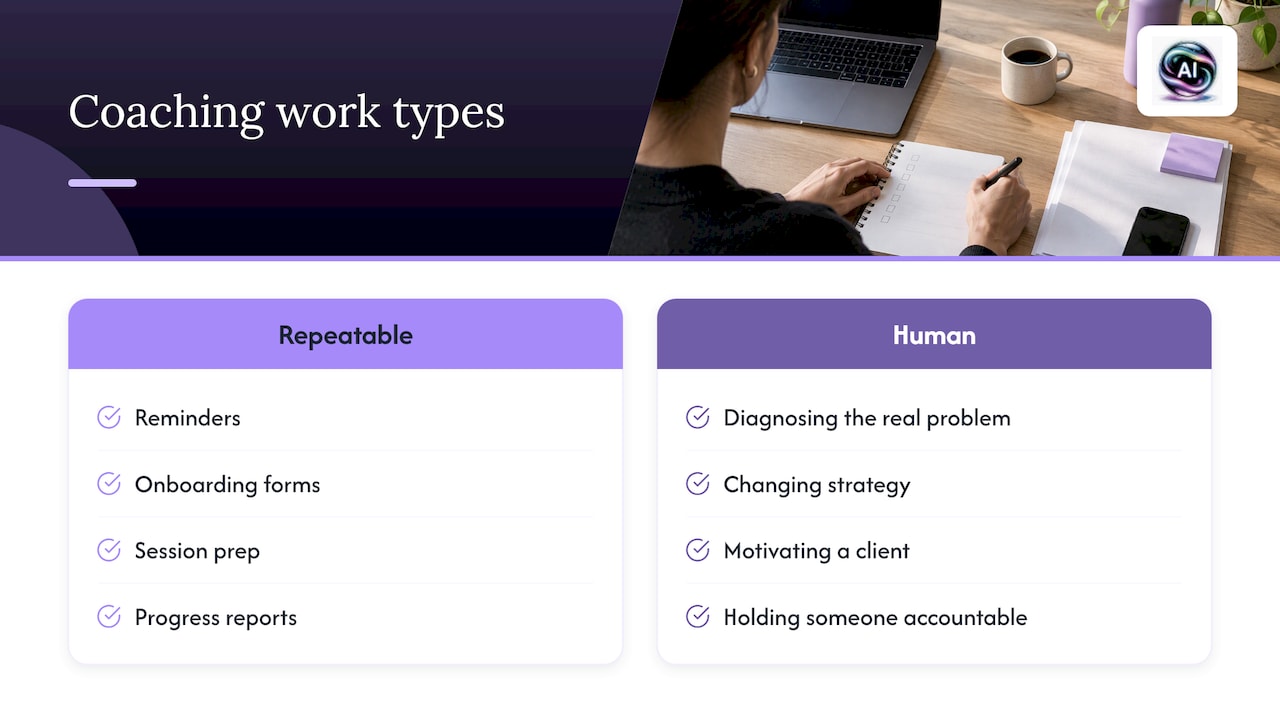
Try this on each step. Would a smart new hire get it right with a checklist? Then it is repeatable. Would they need your gut? Then it is human. Do not stop there, though. Human work can still be taught. That is Step 3.
Step 3: Write down your decisions
This step matters most. It is also the hardest.
Checklists tell people what to do. They do not tell people what to decide. A client misses two sessions. Do you push, pause or call? Your answer depends on a dozen small signals.
Capture those signals. For each key moment, write:
- The trigger. What starts this moment?
- What you look at. Which signals do you check?
- What you decide. And why?
- What good looks like. The finished result.
- The exceptions. When the usual answer is wrong.
The easiest way to get this out of your head is to talk it through. Walk a colleague through five real client cases out loud. Record it. The patterns show up fast.
Keep the result short. A playbook people read beats a manual people ignore. One guide suggests 30 to 50 pages for the core, tested by someone who was not in the room, and reviewed every quarter or twice a year. Your method will change. The document should too.
Our page on IP extraction shows how we turn a founder's method into a working system.
Step 4: Give every step an owner
Writing it down is half the job. The other half is who does what.
We have no checked research on team roles for coaching, so here is plain practice. Make a simple table. One row per step.
| Step | Owner | Trigger | Done when |
|---|---|---|---|
| Enquiry reply | Client manager | New form arrives | Reply sent and call booked |
| Onboarding | Client manager | Payment received | Client has intake form and first date |
| Weekly session | Coach | Calendar slot | Notes filed, homework set |
| Homework review | Coach or assistant | Client submits work | Feedback sent |
| Progress check | Coach lead | Every four weeks | Report shared with client |
| Hard cases | Founder | Coach flags a stuck client | Plan agreed and written down |
Three rules keep this honest:
- One owner per step. Two owners means no owner.
- A clear trigger. People should not need to remember.
- A way to escalate. Your team needs to know when to call you, and what to bring.
The escalation rule gives you your time back. Without it, everything comes to you. With it, only real exceptions do. Each exception then becomes a new line in the playbook.
Step 5: Add tools, then AI
Order matters here. Method first. Tools second.
A calendar, a client record and a shared folder carry a lot of the load. They remove the small admin that eats a week. Our guide on what to automate first in your coaching business lists the first wins.
AI is the next layer. Think of it as a trained assistant who has read your playbook. It can draft a session summary in your style. It can suggest a next step when a client stalls. It can answer your team's common questions at 9pm, so they do not wait for you.
This only works if the playbook is good. An assistant with no recipe makes generic food. That is why we do the method first.
The build tool we use for this is Claude Code. It lets a non-technical founder turn a written method into reusable skills that an AI assistant follows the same way each time. Each skill holds one decision from your playbook. Together they act like a small team of AI employees that carry your thinking. See how Claude Code builds custom delivery systems for the detail.
Keep it simple at the start. Anthropic's own advice on building effective agents is to begin with the simplest thing that works and add complexity only when it earns its place. That fits coaching well.
Some limits to respect:
- Keep a person in the loop for anything sensitive.
- Review early outputs yourself, then less often.
- Start with a small pilot. Our AI coaching assistant pilot guide uses 5 clients over 6 weeks.
For the bigger picture, see the AI delivery stack for coaching businesses. Njin has a plain take on the same idea in what an AI operating system for business is.
Step 6: Measure results, not activity
Sessions held and messages sent are easy to count. They tell you little.
Track what clients actually gain. Did they hit the goal? Did the habit stick? Did they renew or refer someone? One AI coaching platform review makes the same point: behaviour change is a harder and more useful measure than engagement.
Pick three numbers and check them monthly. If you want help choosing, this guide on how to measure results with the right KPIs shows how to match metrics to goals.
Then compare clients served by you with clients served by the team. If they match, the system works. If not, the gap shows you which page of the playbook is thin.
Common mistakes
- Writing steps, not decisions. Checklists alone give you a faster version of the same mistakes.
- A 200-page manual. Nobody opens it.
- Skipping the test. If someone else cannot follow it, it is not done.
- Automating a messy process. You just get mess, faster.
- Removing yourself overnight. Step back in stages. Watch quality at each stage.
Where we come in
Most founders can do Steps 1 and 2 alone. Steps 3 to 5 are where it stalls. You are too close to your own method to see what you do.
We work one on one with each founder. Never in cohorts. We turn your method into an always-on AI operating systemNoun · glossaryAn AI operating system is the shared layer a business runs its AI on: the models, the packaged know-how, the memory, the live connections to real tools, and the jobs that run on a clock.Read the full entry →, a set of AI helpers that each have a job, and we train your team to use it.
That is the AI Orchestrator OS: $30,000, or 3 x $11,000. It includes 6 weeks of 1 on 1 setup coaching, IP extraction, team training and framework sharing. You bring your own Mac, or we order one for you. It is not included in the price.
After setup, 1 on 1 coaching runs from $1,950 a month. See coaching for the tiers. The platform is free for 12 months with the OS, then $90 a month.
If you would rather have us build it for you, that is done for you, by quote.
We see one pattern again and again. A founder is great at the work. The team is capable. But the founder's judgment never made it onto paper.
So we start there. We sit with you and pull out how you think. What you notice in a client. Why you choose one move over another.
Then we build AI helpers that carry that thinking, and your people use them to deliver to your standard.
You stay the chef. You set the taste.
James Killick
FAQ
How long does it take to systemize coaching delivery?
Mapping the journey and sorting steps can take a week or two. Capturing your decisions takes longer, because you need real client cases. Plan on a few weeks of steady work to get a first version your team can test.
Will systemizing make my coaching feel cold?
Not if you do it right. You standardise the admin and the structure. You protect the human moments, like diagnosis and encouragement. Clients usually feel more cared for, because nothing gets dropped.
What should I write down first?
Start with the moments that pull you in most. That is often the hard client call, the progress review or the onboarding. Write the trigger, what you look at, what you decide and what good looks like.
Can AI deliver my coaching for me?
AI can handle drafts, summaries, reminders and common questions in your style. It works best after your method is written down. Your team still owns the human moments and the sensitive calls.
Do I need a big team first?
No. Even one assistant and one coach benefit from clear steps and owners. A system is what lets a small team grow without everything coming back to you.
Your next step
Not sure where your delivery leans on you most? Take the assessment and see. Or book a call and we will look at your program together.
Sources
- How to Build a Repeatable Coaching Method That Scales
- Critical Client Flow: Map Your Business
- Coaching Program Architecture for Scalable Growth
- Get Ready to Use Coaching Playbooks: A Practical Guide
- 12 Best AI Coaching Platforms: AI-Only vs Hybrid
- How to measure website success: KPIs, tools, and pro tips
- Building effective agents (Anthropic)
- Claude Code skills (Anthropic docs)
Frequently asked questions.
James Killick
Founder
The AI Orchestrator. 10+ years building digital products and 200+ apps shipped, now helping $1M+ educators and consultants turn their IP into AI-powered delivery systems.
James Killick founded and runs The AI Orchestrators.
More from James Killick